Monday, June 22, 2015

Reading Alley Grand Opening Celebration! #ReadingAlleyEvent


I wanted to share this wonderful new site with you all. If you're an avid reader and enjoy writing reviews, this is a great opportunity to receive free books. Enjoy! ~ Kristy

AN INVITATION

Calling all passionate book reviewers!

Reading Alley is officially launching and we are marking it in a big way with our Grand Opening event! Take part in a variety of site activities, such as our weekly contests, review challenge and referral program. The more active you are, the higher your chances of winning in our Grand Draw. Lots of irresistible prizes, including an Amazon Kindle and gift certificates, are up for grabs.

On June 19, Week 2 of our Weekly Contest goes live. Answer 3 questions and get a chance to win an Amazon Gift Card! Each week, we will have different winners, for a total of 12 winners by the time the party is over.

So don't wait! Click here to join now.


WHAT IS READING ALLEY?

Reading Alley is a site that caters to passionate book reviewers. Book reviewers get the chance to read the latest books in the market for FREE. In exchange, the only requirement is for them to submit their honest, unbiased review afterwards.

We feature a variety of books from different genres such as Romance, Mystery and Thriller, Erotica, LGBTQ, New Adult, Science Fiction and Fantasy, Young Adult, and more. These books are from both known and up-and-coming authors. Examples of books currently up for review at the site are:


Authors are welcome to set up their books for review at a reasonable price. By joining Reading Alley, authors gain instant access to this community of reviewers who can share their thoughts and recommendations, leading to greater awareness and exposure of their books.

If you wish to learn more, click here.

Otherwise, sign up for a free account now and join our Grand Opening celebration!

See you there!

Follow Reading Alley

Facebook
Twitter

Tuesday, June 2, 2015

Science Facts

By Kristy McCaffrey

Scientists at the University of Portsmouth have published a study that women wearing high heels are more attractive to men than women who don’t. High heels require a slightly adjusted way of walking, one that involves shorter steps and more hip movement, giving women a more feminine gait.

Mice permanently lose their fear of felines following infection with a parasite that cats carry. The brazen behavior carries on long after the infection clears.

Snow leopards have low levels of genetic diversity, nearly half that of the other big cat species. Low genetic diversity can be a sign that a species is headed toward extinction.


Physical order produces healthy choices, generosity, and conventionality, whereas disorder produces creativity.

Researchers have known for decades that if you cool liquid helium just a few degrees below its boiling point of -452 degrees Fahrenheit (-269 degrees Celsius) it will suddenly be able to do things that other fluids can't, like dribble through molecule-thin cracks, climb up and over the sides of a dish, and remain motionless when its container is spun.

Identical twins aren't completely the same, and it's not due to differences in nurturing. Geneticist Carl Bruder of the University of Alabama at Birmingham and his colleagues closely compared the genomes of 19 sets of identical adult twins. In some cases, one twin's DNA differed from the other's at various points on their genomes. At these sites of genetic divergenct, one bore a different number of copies of the same gene, a genetic state called copy number variants.

When feeding, leeches use their suckers to attach to their hosts, releasing an anesthetic, which helps prevent them from being detected as well as serving as an anticoagulant, which prompts continued bleeding.

A 20-ounce bottle of cola contains the equivalent of 16 sugar cubes.

The scientists who discovered sucralose (now sold as Splenda) were originally trying to create an insecticide. An assistant thought he had been instructed to "taste" a compound he'd only been asked to "test."

Sugars are the building blocks of carbohydrates, the most abundant type of organic molecules in living things.

Researchers at Queen Mary University and Imperial College London report that exposing solar cells to pop music makes them convert sunlight into electricity up to 50 percent more efficiently. Solar cells, expensive to produce, create up to 40 percent more electricity while listening to the higher pitches found in pop and rock music. Similar test conducted with classical music, typically of darker tones than pop, did not yield the same beneficial effects.


Thursday, May 21, 2015

Raising My Children

By Kristy McCaffrey

This week, I have another child graduating from high school. What do I know about parenting? Mostly, it’s a very humbling endeavor. I’ve made many mistakes, out of both love and anger, but thankfully, children are resilient little creatures. Here’s a few words of wisdom.

Katy graduating from Kindergarten.
Today, she graduates from high school.

When children are young, hide the permanent markers.

If you’ve just cleaned your kitchen floor, don’t serve grape juice for lunch.

Crayons make great snacks.

You’ll acquire the most gray hair during the terrible two’s and the teenage years.

My son Ben at age 2. Today, he's 19.

Keep a baby book and describe the personality of your child when they’re young. You’ll be shocked by how it doesn’t change over the years.

My children are a part of me, but in so many ways, they’re not like me. My assumption that they would think and behave in similar ways to myself has led to misunderstandings, fighting, and unnecessary struggles at school. If possible, try to lift that lens through which you view your children and see who they really are. Proceed accordingly.

When separated from their siblings for weeks and months at a time, my children become much nicer individuals. It’s like shining a light into their soul. Sweet love.

My youngest, Hannah, at 9 months old.
She'll be driving soon.

Telling your children that you’ll no longer do their laundry doesn’t work. A full-blown strike is required to ignite a love of clean clothes. (This goes for ironing, too.)

When, oh when, will cell phones be made with shatterproof glass?

You’ll never decipher why they listen to some of your advice and completely ignore other helpful hints you try to throw their way. So, keep blabbing away!

When my oldest son was born premature, a nurse in the neonatal intensive care unit gave me guidance—don’t waste what time you have with your child. You don’t know how long you have. Make the most of every day.

My son Sam in the Neonatal Intensive Care Unit at Magee-Women's
Hospital in Pittsburgh, PA. He's about to turn 21.

And finally, let them go. I’m still working on this.


Mi familia in Scotland.

Monday, May 4, 2015

New Release - The Blackbird by Kristy McCaffrey

I'm so pleased to announce that Book Four in my Wings of the West series, The Blackbird, is now available in digital formats!!

Historical Western Romance
Rating: Steamy


Arizona Territory 1877

Bounty hunter Cale Walker arrives in Tucson to search for J. Howard “Hank” Carlisle at the request of his daughter, Tess. Hank mentored Cale before a falling out divided them, and a mountain lion attack left Cale nearly dead. Rescued by a band of Nednai Apache, his wounds were considered a powerful omen and he was taught the ways of a di-yin, or a medicine man. To locate Hank, Cale must enter the Dragoon Mountains, straddling two worlds that no longer fit. But he has an even bigger problem—finding a way into the heart of a young woman determined to live life as a bystander.


For two years, Tess Carlisle has tried to heal the mental and physical wounds of a deadly assault by one of her papá’s men. Continuing the traditions of her Mexican heritage, she has honed her skills as a cuentista, a storyteller and a Keeper of the Old Ways. But with no contact from her father since the attack, she fears the worst. Tess knows that to reenter Hank Carlisle’s world is a dangerous endeavor, and her only hope is Cale Walker, a man unlike any she has ever known. Determined to make a journey that could lead straight into the path of her attacker, she hardens her resolve along with her heart. But Cale makes her yearn for something she vowed she never would—love.


First Kiss Excerpt

After they ate and cleaned up, Tess excused herself and went behind the mesquite for privacy, limping but determined to not use her cane. After attending to personal matters, she paused to watch the still nearly-full moon shining brightly in the starry sky. The horses snorted nearby, and she went to them for a brief visit. Gideon happily greeted her with a nudge, and to Tess’s surprise, so did Bo. 

She reveled in the affection of the two boys, but when she moved to Moses he rebuffed her, which also made her smile.

“I can respect that,” she whispered.

As she walked back toward Cale and the fire, her foot caught on a rock and she tripped. Falling to the side, she landed hard against a boulder with her injured leg. She must have screamed because Cale appeared within seconds.

“What happened?” he asked. “I was getting concerned when you didn’t return.”

“Nothing.” Hating her weakness, she tried to push his hands away and stand, but her leg gave out. He caught her and held her upright. “I just fell, that's all. I'll be fine. Just give me a moment.”

Cale lifted her into his arms and carried her back to the fire. He settled her atop her pallet and knelt before her. “Tess, will you let me have a look at it?”

Panic swept her. “No.”

“What are you afraid of? That I haven't seen anything so hideous before?”

A response clogged her throat.

He removed his vest, then began unbuttoning the placket on his blue chambray shirt. Alarm snaked down her spine. “What...what are you...”

“I want to show you my injury.”

“Oh.” She really couldn't reconcile her ambivalence. On the one hand, any overture by a man that came close to indicating sexual contact set her heart to pounding and filled her with an overwhelming urge to flee. On the other, slivers of curiosity sometimes whispered in her ear, of what it could be like with a man who cared, of what hidden magic such contact could hold. She carried many stories in her repertoire, and there had been those of wild, desperate longings between a man and a woman, of a love so fierce it changed the world. Could those tales be believed? What would it be like to love a man such as Cale?

He pulled his shirt over his head, and shifted to face her better. Her eyes settled onto his right shoulder. Mottled and disfigured, it was covered with scars intersecting like a spider's web. More marks ran across his chest and ribs, prohibiting the growth of hair in places. He twisted his torso to show her a large, disfigured patch of injured flesh just above his trousers.

“The attack must have been thorough,” she whispered, stunned by what she saw. “Are you in any pain?”

“At times, but it's almost a phantom pain, pulsing with a memory of what it once was.”

She nodded, understanding. “Did it reach the muscle?”

“Some. I can't rotate my arm completely.”

“How can you shoot?”

“It's not bad now. I became proficient using my left arm, for many things.”

She swallowed down her reticence, and pulled the skirt to her waist along with the petticoat. Unable to look at Cale, she kept her gaze down. She brought the drawers as high as she could then rolled the stocking to the edge of her boot so that Cale could see her leg.

He shifted closer and brought a large hand to the side of her calf, causing an involuntary flinch from her.

“Easy.” He studied her leg in the firelight.

She tried to suppress her unease, but her body began to tremble. Shifting her focus to his close proximity, she studied his wide shoulders, noticing the sheen of sweat on his muscled arms. Despite his disfigurement, it was obvious he was a strong man. It both unnerved and drew her in.

He brought his other hand to her leg and the warmth of his touch spread across her skin. As he gently probed the long-healed injury, the shaking of her body increased. Her heart drummed swiftly in her chest, and she struggled to breathe.

Cale brought his gaze to hers, and for a moment their eyes locked. The sadness reflected back caught her unaware.

“Tess, I'm not going to hurt you.” He gently repositioned her stocking, then the pantalets, then the skirt, and scooted away from her. He donned his shirt.

Tension began to drain from her, replaced by a bone-draining exhaustion. “I know.” She’d barely gotten the words out.

“Your leg doesn't look that bad.” Using a stick, he pushed the burning fire around a bit.

Tess tried to suppress the tears, but one slid down her cheek. Thankfully, Cale pretended not to notice.

“The injury is much more than the leg,” she said thickly.

He did look at her now, but she kept her eyes on the flames before her.

“You can recover from that, too.”

She hung her head. “How?” The sob escaped before she could stop it.

“What do you dream about?”

She wiped at her face and frowned. “I'm not sure what you mean.”

“What do you normally dream about?”

“I dream of mi abuela.” She shifted her injured leg to a bent position. It was sore but this sometimes helped the pulsating pain to abate. “I dream of her a lot, actually. I also dream of Hank. Those are usually angry, or rather I'm very angry. I act the role of a shrew. And I dream of...Saul. I don't like those. I try not to remember them.”

“The Apache believe dreams are much more than just stories in our heads at night,” Cale said. “Actually, I've met many Indians—and some gringos—who believe the same. Within dreams we can sometimes make peace in a way we can't do in the waking world.”

“How would I do that?”

“Next time you're with Miller, try to move in the dream differently than you normally do. Try to be more decisive. Maybe fight back.”

Rage flared inside her in an instant. “I fought back.”

“No, that's not what I meant.” He held up his hand. “I'm sorry. I'm not insinuating anything. I just meant that slowly, while inside that dream, try to change the outcome.”

“But what would that do? Turn back time? Make it never happen?”

“No, of course not. But it will heal your spirit.” His gaze met hers. “It'll take time, but it can work.”

“Has this technique helped you?”

“It has.” Cale rubbed the back of his neck then rested an arm on a bent knee, releasing a frustrated sigh. “But some wounds are deep. They have to be peeled away layer by layer, much like an onion. I’m still working on mine, and I’ll admit that the remorse and the shame never quite disappear. But the memory doesn’t sting like a wasp anymore.

“How long do you want to keep suffering?” he continued, his voice sympathetic. “Months, years? You’re eighteen years old, Tess. You're a beautiful young woman with an injured leg, who's thinking of joining a convent so no man will never touch you again. If that's what you truly want, then so be it. But don't let that bastard take your entire life from you before you've had the chance to choose. And by bastard, I mean not just Saul, but Hank, too.”

“You speak about it like it's the easiest thing in the world.”

“Of course it's not easy. Life is a shithole sometimes.” He shook his head. “I’m sorry for the language, but I don't like seeing you recoil like a frightened animal.”

Shame flooded her from the trembling earlier.

Cale moved to her and gripped her shoulders. “You can overcome this. Not every man is out to hurt you.” He brought his hands to her face and cupped her cheeks.

She knew he would kiss her.

She wanted him to, but at the same time her body rebelled, so she closed her eyes.

“Go ahead,” she whispered.

She was surprised by the barest brush of his lips against hers. Slowly, he made more contact, kissing her gently, but with each pass he deepened the connection more. For Tess, it was achingly sweet, sweeter than she'd ever imagined. But her body shook, from head to toe, and her ragged breathing made it difficult for her to calm down, to enjoy her first, real kiss.

He settled in closer, kneeling before her. She kept her eyes shut as his thumb caressed her lower lip, as he nuzzled her cheek.

“Look at me, Tess.” Despite the demand, his voice was kind.

She opened her eyes. His face hovered close to hers, and a hint of a smile tugged at his lips. He only touched her face, nowhere else.

His blue eyes held desire, but he seemed in no hurry to move any faster.

Although he made a point to shave every few days, his newly-budding whiskers poked her. Despite his restraint, his mouth met hers with a growing hunger, stirring a longing that grew inside her abdomen. He tasted of coffee and the stew they’d just eaten, and she liked it.

His mouth retreated, but she moved forward and kissed him, not wanting the contact to stop. He responded, molding his lips over hers. Her hands grasped his wrists, wanting to touch him but hesitant to initiate more.

The kiss became more urgent, and when Tess opened her lips his tongue swept briefly inside, shocking her. She stilled.

He pulled back, but his face remained only inches from hers.

“You don't have to worry,” he said. “You can set the pace. You can always tell me to stop.”

She wanted to believe him. “Why would you do this when there are other women with far less difficulties?”

He grinned and leaned away. “None of ’em are you.”

She didn't know what to say.

Did he mean it? Did it matter if he didn't?

Perhaps she could learn to trust again, to decide if life in a convent was truly the best course of action.

Cale called to her like the magic in a story, giving hope in the words that weren't said. The taste of him lingered on her lips, and her body hummed with something other than panic.

“I have something that might help with the pain in your leg,” he said. She watched him retrieve two fist-sized stones from the fire by pushing them from the flames with a stick, then he placed them in an empty grain sack.

He came to her and crouched, and she wondered if he would kiss her again.

“I’m gonna put this around your knee,” he said. “Then you should try to get some sleep. The heat will help relax the muscles.”

She gave a brief nod when he paused for her permission. Lifting her skirt once again, he wrapped the sack and the hot stones around her damaged leg. She settled onto her pallet as he adjusted the bundle, then pulled the skirt back in place and settled a blanket atop her.

He retrieved a plain buckskin pouch from his belongings, opened it and coated a finger with the yellow substance inside.

“Open your mouth,” he instructed.

“What is that?”

“Ha-dintin. It’s tule pollen, and very sacred to the Apache. It’s also thought to aid in healing.”

She let him slide his finger along her tongue to deposit the substance. The dense powder left a slightly sweet taste.

He leaned down and kissed her forehead. She grabbed his hand to keep him near. Impulsively, she lifted her head to bring her lips to his.

Despite the terror that pressed in on her, she wanted very much to show Cale that she welcomed his touch.

“I should’ve heated stones for you sooner,” he murmured against her mouth.

“Gracias,” she whispered.

“Sleep well, Tess. Let me guard the shadows for once.”

He slept near to her, and she was glad for his company.

Copyright © 2015 K. McCaffrey LLC

Thursday, April 2, 2015

Evolution Of A Novel

By Kristy McCaffrey

I’m in the process of readying my fifth novel for release. While I would love to say that I know the ins-and-outs of this writing thing, I can’t. Each book I’ve penned presents its own challenges, and with each I was at a different stage of my composition skills.

This is the first book that I’ve written fast. I’ve always called myself a slow writer because I was. Toiling away with a small press meant no real deadlines, so I never gave myself any either. I wrote to my creative whims. If I came to a crossroads in a story and was unsure of the direction, I easily took a three month break to await inspiration. As you can imagine, it took me years to write my first four books.

An important aspect of this slowness concerned my writing confidence. While I can’t say I’m super-assured at this point, I did make a deliberate effort to improve my skills, to network with other writers who could help me, to read more, and to look up grammar issues to make sure I was getting it right. I also had the opportunity to clean up my first three books to re-release them. That was an eye-opener. The sloppiness in prose jumped off the pages. I think the simple fact that I could recognize this helped me feel more convinced that my skills have improved (all cringing aside).

I wrote the first draft of THE BLACKBIRD (Book Four in my Wings of the West historical western romance series) in one push during the month of November. I participated in National Novel Writing Month, a worldwide endeavor to finish a novel in 30 days. I’d never done anything like it before, and I’d certainly never written so quickly. I was curious to try.


To ‘win’ the challenge, writers had to type out 50,000 words. This isn’t quite the length of a novel since most are around 70-80,000 words, but the goal was to get a decent outline completed. I quickly realized that to hit my daily word count of 2000 (I knew I’d have to take off Thanksgiving at the end of the month so I wrote more than the recommended 1667 words each day), I couldn’t move slowly or dawdle too much on my characters, or descriptions, or the plot. Some writers are pantsers, living in a world where ‘what will come will come’, but I wasn’t one of those. I had to discard all my carefully laid plans of meticulous research. This was especially grueling as I built three chapters around a fort in the Arizona Territory I wasn’t even certain existed.

It was a wild November (we writers do love the crazy), but I did it. And, I pushed to get to the end of the book. I did this by glossing over certain scenes, then moving on. I skipped descriptions—the hero carried a gun and rode a horse but I didn’t know what kind. I wrote hero’s backstory (with the Apache Indians) by using markers like ‘B Indian talks to C Indian from the D tribe’. But don’t get me wrong, I did do preliminary research in October to make sure I was heading generally in the right direction. There were, however, many details I simply didn’t have time to fact-check if I wanted to make my word count each day.

This type of intuitive writing is both exhilarating and scary. It can lead to serious misdirection, and hence much rewriting, but it also lets the plot breathe through the writer unfettered. I found hidden gems in the story I had no idea were present, such as what really happened to the heroine when she was assaulted two years prior. The twist really surprised me. But in the rough edges of this first draft I also found I needed additional time to find the best way to tie it all up, to cut away the fluff. This is where my best-laid plans suffered. I was unable to meet my March 2015 release date. I pushed it to April, and began worrying about whether I’d get it done by then, too.

By mid-March, I made it through a fairly thorough edit of the first draft, cleaning up and tying bows and ribbons wherever I could, but as I got near the end I found a major glitch. I needed a better motivation between the bad guy and the heroine’s father, a rather ambiguous character who I hadn’t decided was good OR bad. My husband offered to help. Over dinner, I explained the story—and many subplots. It was impressive that he didn’t doze off. Finally, his advice was to offer a simple explanation for why something had happened in the backstory. And he was right. When in doubt, take the most obvious, easiest solution because that will make the most sense. The key, of course, is not to reveal all this to the reader, doling it out throughout the story.


So, back to another editing pass. I’m just about complete with it, then it’ll go to the editor. Despite a deadline looming, this is really the most fun part of penning a novel, at least for me. It’s when the very finest of details are added, and it always feels like packing moist, sweet earth into the cracks of the world I’ve created.

Hang tight, readers. I’ll get this published by the end of April. Cheers!


Arizona Territory 1877

Bounty hunter Cale Walker arrives in Tucson to search for J. Howard “Hank” Carlisle at the request of his daughter, Tess. Hank mentored Cale before a falling out divided them, and a mountain lion attack left Cale nearly dead. Rescued by a band of Nednai Apache, his wounds were considered a powerful omen and he was taught the ways of a di-yin, or a medicine man. To locate Hank, Cale must enter the Dragoon Mountains, straddling two worlds that no longer fit. But he has an even bigger problem—finding a way into the heart of a young woman determined to live life as a bystander.

For two years, Tess Carlisle has tried to heal the mental and physical wounds of a deadly assault by one of her papá’s men. Continuing the traditions of her Mexican heritage, she has honed her skills as a cuentista, a storyteller and a Keeper of the Old Ways. But with no contact from her father since the attack, she fears the worst. Tess knows that to reenter Hank Carlisle’s world is a dangerous endeavor, and her only hope is Cale Walker, a man unlike any she has ever known. Determined to make a journey that could lead straight into the path of her attacker, she hardens her resolve along with her heart. But Cale makes her yearn for something she vowed she never would—love.


Sunday, March 15, 2015

Pacific Gray Whales: The Sequel

By Kristy McCaffrey

“Out there are whales, living by light and ancient brain...”
           ~ Brenda Peterson and Linda Hogan, Sightings

“Unbelievable.”

We’re sitting in a military airport lounge in Ensenada awaiting a 2-1/2 hour flight to San Ignacio Lagoon, a remote inlet on the Pacific side of Baja California Sur and the only undeveloped nursery and breeding ground for gray whales in the world. Guests returning from the lagoon have disembarked from the propeller-driven plane we’re about to board and crowd into the waiting area, queuing up for a bag search before they can move on. They are sunburned, their hair askew, but are more than pleased to pass along what they experienced in one-word revelations.

“Fantastic.”

“Magnificent.”

A Pacific Gray whale.

They’ve just spent three days interacting with Pacific Gray whales in one of three calving lagoons located in Baja Mexico. I know of what they speak, having done it myself last April for one afternoon. The extraordinary experience left me awestruck, and you can read that blog post here. Naturally, I wanted to return and immediately began planning it. Because I craved more time with the leviathans, I booked a 5-day trip at a camp along the shores of the lagoon. I also brought along my husband, and my oldest son Sam and his girlfriend Alex. They were Baja-newbies. Soon, they’d be initiates to a remarkable communion between man and whale.

My husband and I at the dirt airstrip at San Ignacio Lagoon,
Baja California Sur, Mexico.

The plane ride offers our first glimpse of the whales, and I press my face to the window with longing. The 35- to 45-foot beauties are about the size of a piece of rice. We probably wouldn’t have noticed them if the pilot, Enrique, hadn’t pointed them out. The anticipation builds.

Flying over San Ignacio Lagoon.


Our cabins at Campo Cortez, run by Baja Ecotours.

After many hours of travel by air and bus, we arrive at the lagoon along with 20 other intrepid travelers. This isn’t the type of excursion a casual tourist takes. Campo Cortez is run by Baja Ecotours. It’s small, clean, and efficient, utilizing mostly wind and solar power. Everyone disburses to individual huts that have electrical outlets with enough juice to charge most devices (i.e. camera batteries—there is no internet or cell service so we all shut our phones off); laptops must be plugged in at the palapa, or dining hall. There are four toilets and two showers, although it’s recommended that you bathe every other day since fresh water must be trucked in.

Inside our cabin.

Our first Baja sunset. On the right is a giant Osprey, or Sea Hawk, nest.

As darkness descends, the night sky is unlike any I’ve ever experienced. There are no towns, no lights, no airplanes overhead. The arm of the Milky Way streaks above us and I’m witness to a starry sky that our ancestors viewed nightly. I wonder what the whales are doing. Is day and night so different for them? Do they sleep? For months I’ve educated myself about the Pacific Gray whale, but I’m hungry for more. In the palapa is a shelf filled with books about Eschrichtius robustus. Here is what I learn.

A Pacific Gray whale calf and mother.

** Pacific Gray whales have twice almost been slaughtered to extinction. In 1946 they were placed under protection and their numbers have rebounded to over 20,000. Unfortunately, the North Atlantic Gray whales didn’t fair as well. They are extinct. The Western North Pacific Gray whale, located in the waters north of Japan, is currently struggling in numbers, with as few as 130 remaining.

** Female grays are larger than males.

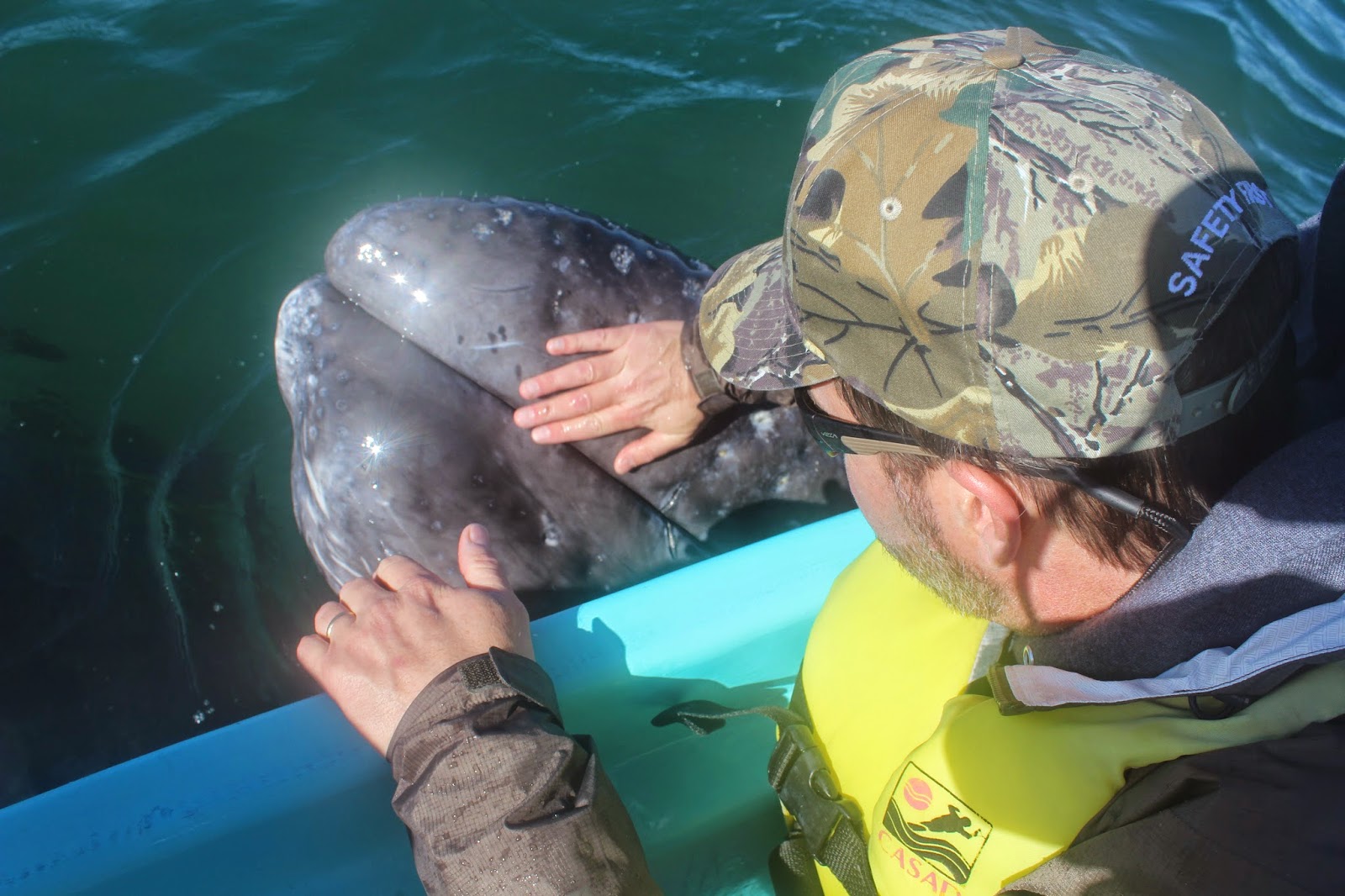
My husband making contact with an adult gray female.

** Pacific Gray whales have one of the longest migrations of any creature on Earth. They travel from the cold, food-rich waters north of Alaska in the summer to the warm Baja lagoons to mate and give birth during the winter and then back again, traveling well over 10,000 miles.

** Mating takes several days and usually involves two males and one female, although it’s not unheard of for dozens of whales to congregate for a massive love-fest.

A gray calf approaches our panga.

** Gray whales can live 50-70 years, and maybe even longer. The longest living whale, however, is the bowhead. Some have been found to be over 200 years old, determined by old spearheads embedded in their flesh. Other long-living creatures are tortoises (150 years) and giant clams (220 years).

** One origin for the word ‘whale’ may come from the Old English ‘Hval’, meaning wheel—a whale’s body rolls through the water.

Sam touching an adult female. She is heavily barnacled.

** Baby gray whales gain 190 lbs. per day while nursing in the lagoon. They don’t suckle but rather bump a slit on mom’s belly which stimulates a squirt of fat-rich milk. It’s the consistency of toothpaste, making it easy for the calf to swallow in the water.

** Baby grays are born tail first and there is usually another female present who acts as a midwife.

A gray calf opens its mouth, exposing the baleen at the top of its jaw.

** There is an account of a male calf left in the lagoon for an entire year rather than migrating north. Motherless, he lived in the inlet until the grays returned. He managed to survive on what little food was present in the lagoon, although he was quite thin.

** Last year an adult gray became stranded on a sandbar while trying to leave the lagoon. Several panga boats (26-foot open skiffs used for whale viewing) were brought in and drivers, called pangueros, swirled the water so that the whale was able to dislodge himself.

My husband and his new friend, a baby gray whale.

** The whales begin arriving into the lagoon in January. Mating and birthing commences. By the end of February the males and single females begin leaving in droves to start the long swim north. The mothers with calves, however, remain as long as they can to get the young big and strong. Mom isn’t eating though and can’t remain indefinitely. March and early April are good times for human-whale interaction, as mom and babies are ‘hanging out’. It’s thought playing with the humans on the boats is a diversion for the whales.

** Gray whales are bottom-feeders, creating trenches on the sea floor. The only animal who alters their environment more are elephants.

Sam and a baby gray whale.

On our first trip into the lagoon we’re gifted with a mother and calf who seek contact with those of us on the panga. I can’t stop grinning. Giant whales are swimming right up to us. The mother, between 35 and 45 feet long, takes up residence in the water beside our small skiff. She’s huge. No photo can prepare you for what it’s like to be near something that huge. (Hint: she’s about the size of a school bus.) We’re in the open ocean—the San Ignacio Lagoon is a misnomer. Yes, it’s buffered by land, but it’s really just a giant swath of ocean, and a home for giant mammals. Have I said how big they are?

Our panga.


A baby gray swims by.

These magnificent creatures have arrived to check us out, to interact with us, to see us. I’m humbled by their trust, by their curiosity and, ultimately, by their graciousness.

My husband with an adult female. They generally stayed away, letting
the babies do all the playing, but this one was very friendly. If you look
closely you can see her eye. She's rolled to the side so she can get a good
look at my hubby. 

I'm one happy girl. This is a baby and they have the personalities of
puppies.

A Pacific Gray whale calf. Beautiful.

Alex communing with a baby gray.

Mother and calf court us with swimming and diving, watching us with their soulful eyes, enjoying it when we rub their snouts. They nudge the boat and mom hovers underneath, always watchful of her baby. They twist and roll, and when mom does dive beneath the panga she keeps her fins close to her body. They are gentle, inquisitive, and playful and stay with us for at least 45 minutes. I know I’m not the only one on the boat who is utterly in love. We would have five more trips into the lagoon, but this one is blessed in a way that only hindsight can recognize.

This panga wasn't in our group, so I don't know these people. I hope they
find this photo because that baby really came out of the water for a kiss.

On one afternoon excursion, despite at least 8-10 mother-calf pairs swimming around us, not one whale comes to our boat. With several pangas floating in the area, the whales perform dozens of spy-hops—popping their heads out of the water to have a look around. We even witness a baby attempt one. Why do they choose to interact some days and not others? One possibility is the wind, which has picked up speed, the lagoon awash in whitecaps. Conditions like this may deter the mothers. This theory gains traction when, the following gusty afternoon, a baby smashes his nose into our boat while attempting to maneuver close. Ouch.

An adult female spy-hops to have a look around.

Spy-hopping. This behavior is very frequent in the lagoons, but less so
as the whales migrate north.

But I also sense that the whales have other matters that require their focus. At times, an approaching calf would be cut off by mom. Perhaps she’s telling her youngster something like, “Pay attention. Today we’re practicing our diving. You can play with the humans once you’ve completed your lessons.”

A baby gray whale, probably about 2 months old.

Sam with a baby. They often roll to the sides so they can see you.

The viewing area is in the lower section of San Ignacio Lagoon. Outside of it, the whales are to be left alone. The shallow upper lagoon is where the females give birth and care for the newborn calves. In the middle lagoon, the mothers swim with the babies to strengthen their skills. It’s in the lower lagoon that much of the social behavior occurs, and where the whales come to meet the curious and ecstatic people who’ve come from all over the world to greet them. Also, perhaps the moms need an extracurricular activity for the babies, and humans make great babysitters.

Despite all the commotion present in the viewing area—or maybe because of it—we come across a mother and calf resting. This behavior is easier to recognize than you might think because they literally don’t move from their spot in the water except to rhythmically take a breath, lolling like a couple of giant logs. Whales don’t sleep like we do, but rather rest while part of the brain remains active to insure they continue surface breathing. They also require less slumber than humans.

A tail fluke. This usually precedes a deep dive.

Alex and a baby gray.

The babies would often approach the boats from the stern and work their way
along the side until they'd visited with each person.

To have six excursions into the lagoon allows for the opportunity to observe the whales in many different moods. To me, this is the best part of spending an extended period of time with these amazing creatures. On our very last whale-watch, we have only a bit of interaction but I don’t feel disappointed. As gray whales move around us, I feel privileged to be in their world, if only for a short time. Their presence mixes with my own, and I sense their life-force, as strong and loving and playful as my own. Near the end of our time, a mom surfaces near the boat. We’re downwind of her blow spout and when she exhales, her mist coats us. Then the baby does it. Baptism by whale. I feel it clear to my bones.

A gray whale mother and calf.

Later, as I reflect upon the experience, the tears come. Having direct contact with a species such as this bridges a gap you never knew existed until you’re face to face with them, looking into their eyes, smiling ear-to-ear as the calves poke the boat and spin it in a slow circle. They’re intrigued and playful with us, as curious about humans as we are of them.

Life is ineffable and unexplainable, but the child deep within ourselves doesn’t concern herself with such existential pangs. She opens her arms wide and embraces the world in all its wonder. We are a part of the whales, and they are a part of us. And, like the child, the whales simply remind us to pay attention.

The blow holes of a baby gray. They create a heart-shaped plume.

Jean-Michel Cousteau calls gray whales “breathing planets.” A communion between humans and whales is occurring right now on this planet down in the Baja. The whales are as entranced with us as we are with them. May we make responsible decisions with the earth, for our sake and for these giants who exhibit intelligence and an uncommon compassion.

“Whale watching takes on a whole new world of meaning when the whale is watching you.”
            ~ Dr. Sylvia Earle


Recommended Reading:
Eye of the Whale: Epic Passage from Baja to Siberia by Dick Russell
Sightings by Brenda Peterson and Linda Hogan
Eyes of the Wild by Eleanor O’Hanlon

Until next time...


Stay in touch with Kristy