

By Kristy McCaffrey
“Out there are whales, living by light and ancient brain...”
~ Brenda
Peterson and Linda Hogan, Sightings
“Unbelievable.”
We’re sitting in a military airport lounge in Ensenada
awaiting a 2-1/2 hour flight to San Ignacio Lagoon, a remote inlet on the
Pacific side of Baja California Sur and the only undeveloped nursery and
breeding ground for gray whales in the world. Guests returning from the lagoon have
disembarked from the propeller-driven plane we’re about to board and crowd into
the waiting area, queuing up for a bag search before they can move on. They are
sunburned, their hair askew, but are more than pleased to pass along what they
experienced in one-word revelations.
“Fantastic.”
“Magnificent.”
 |
| A Pacific Gray whale. |
They’ve just spent three days interacting with Pacific Gray
whales in one of three calving lagoons located in Baja Mexico. I know of what
they speak, having done it myself last April for one afternoon. The
extraordinary experience left me awestruck, and you can read that blog post
here. Naturally, I wanted to return and immediately began planning it. Because I
craved more time with the leviathans, I booked a 5-day trip at a camp along the
shores of the lagoon. I also brought along my husband, and my oldest son Sam
and his girlfriend Alex. They were Baja-newbies. Soon, they’d be initiates to a
remarkable communion between man and whale.
 |
| My husband and I at the dirt airstrip at San Ignacio Lagoon, Baja California Sur, Mexico. |
The plane ride offers our first glimpse of the whales, and I
press my face to the window with longing. The 35- to 45-foot beauties are about
the size of a piece of rice. We probably wouldn’t have noticed them if the
pilot, Enrique, hadn’t pointed them out. The anticipation builds.
 |
| Flying over San Ignacio Lagoon. |
 |
| Our cabins at Campo Cortez, run by Baja Ecotours. |
After many hours of travel by air and bus, we arrive at the
lagoon along with 20 other intrepid travelers. This isn’t the type of excursion
a casual tourist takes. Campo Cortez is run by Baja Ecotours. It’s small, clean,
and efficient, utilizing mostly wind and solar power. Everyone disburses to
individual huts that have electrical outlets with enough juice to charge most
devices (i.e. camera batteries—there is no internet or cell service so we all
shut our phones off); laptops must be plugged in at the palapa, or dining hall. There are four toilets and two showers,
although it’s recommended that you bathe every other day since fresh water must
be trucked in.
 |
| Inside our cabin. |
 |
| Our first Baja sunset. On the right is a giant Osprey, or Sea Hawk, nest. |
As darkness descends, the night sky is unlike any I’ve ever
experienced. There are no towns, no lights, no airplanes overhead. The arm of
the Milky Way streaks above us and I’m witness to a starry sky that our
ancestors viewed nightly. I wonder what the whales are doing. Is day and night
so different for them? Do they sleep? For months I’ve educated myself about the
Pacific Gray whale, but I’m hungry for more. In the palapa is a shelf filled with books about Eschrichtius robustus.
Here is what I learn.
 |
| A Pacific Gray whale calf and mother. |
** Pacific Gray whales have twice almost been slaughtered to
extinction. In 1946 they were placed under protection and their numbers have
rebounded to over 20,000. Unfortunately, the North Atlantic Gray whales didn’t
fair as well. They are extinct. The Western North Pacific Gray whale, located
in the waters north of Japan, is currently struggling in numbers, with as few
as 130 remaining.
** Female grays are larger than males.
 |
| My husband making contact with an adult gray female. |
** Pacific Gray whales have one of the longest migrations of
any creature on Earth. They travel from the cold, food-rich waters north of
Alaska in the summer to the warm Baja lagoons to mate and give birth during
the winter and then back again, traveling well over 10,000 miles.
** Mating takes several days and usually involves two males
and one female, although it’s not unheard of for dozens of whales to congregate
for a massive love-fest.
 |
| A gray calf approaches our panga. |
** Gray whales can live 50-70 years, and maybe even longer.
The longest living whale, however, is the bowhead. Some have been found to be
over 200 years old, determined by old spearheads embedded in their flesh. Other
long-living creatures are tortoises (150 years) and giant clams (220 years).
** One origin for the word ‘whale’ may come from the Old
English ‘Hval’, meaning wheel—a whale’s body rolls through the water.
 |
| Sam touching an adult female. She is heavily barnacled. |
** Baby gray whales gain 190 lbs. per day while nursing in
the lagoon. They don’t suckle but rather bump a slit on mom’s belly which
stimulates a squirt of fat-rich milk. It’s the consistency of toothpaste,
making it easy for the calf to swallow in the water.
** Baby grays are born tail first and there is usually
another female present who acts as a midwife.
 |
| A gray calf opens its mouth, exposing the baleen at the top of its jaw. |
** There is an account of a male calf left in the lagoon for
an entire year rather than migrating north. Motherless, he lived in the inlet
until the grays returned. He managed to survive on what little food was present
in the lagoon, although he was quite thin.
** Last year an adult gray became stranded on a sandbar
while trying to leave the lagoon. Several panga
boats (26-foot open skiffs used for whale viewing) were brought in and drivers,
called pangueros, swirled the water
so that the whale was able to dislodge himself.
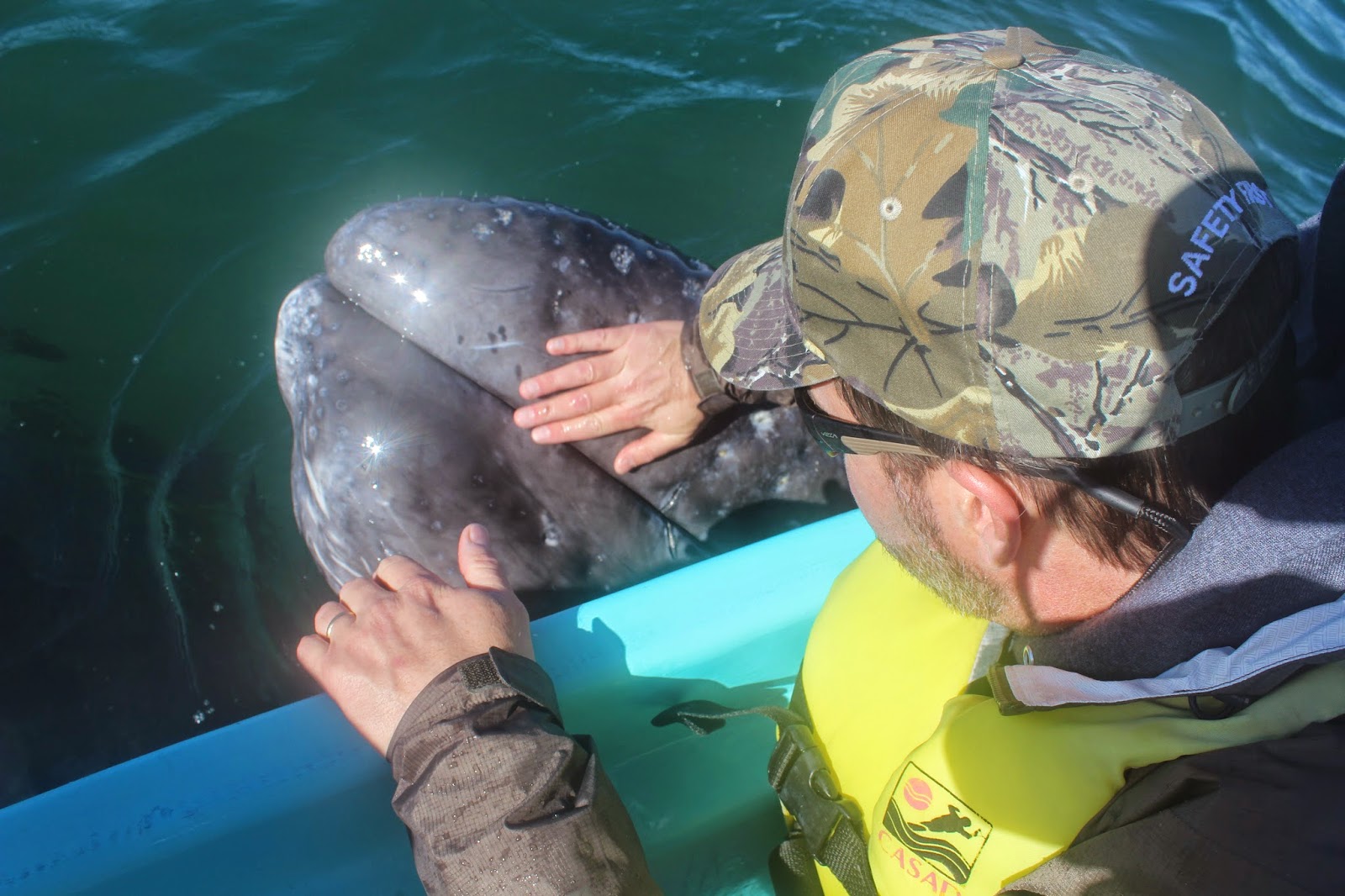 |
| My husband and his new friend, a baby gray whale. |
** The whales begin arriving into the lagoon in January.
Mating and birthing commences. By the end of February the males and single
females begin leaving in droves to start the long swim north. The mothers with
calves, however, remain as long as they can to get the young big and strong.
Mom isn’t eating though and can’t remain indefinitely. March and early April
are good times for human-whale interaction, as mom and babies are ‘hanging
out’. It’s thought playing with the humans on the boats is a diversion for the
whales.
** Gray whales are bottom-feeders, creating trenches on the
sea floor. The only animal who alters their environment more are elephants.
 |
| Sam and a baby gray whale. |
On our first trip into the lagoon we’re gifted with a mother
and calf who seek contact with those of us on the panga. I can’t stop grinning. Giant
whales are swimming right up to us. The mother, between 35 and 45 feet
long, takes up residence in the water beside our small skiff. She’s huge. No
photo can prepare you for what it’s like to be near something that huge. (Hint: she’s about the size
of a school bus.) We’re in the open ocean—the San Ignacio Lagoon is a misnomer.
Yes, it’s buffered by land, but it’s really just a giant swath of ocean, and a
home for giant mammals. Have I said how big they are?
 |
| Our panga. |
 |
| A baby gray swims by. |
These magnificent creatures have arrived to check us out, to
interact with us, to see us. I’m
humbled by their trust, by their curiosity and, ultimately, by their
graciousness.
 |
| My husband with an adult female. They generally stayed away, letting the babies do all the playing, but this one was very friendly. If you look closely you can see her eye. She's rolled to the side so she can get a good look at my hubby. |
 |
| I'm one happy girl. This is a baby and they have the personalities of puppies. |
 |
| A Pacific Gray whale calf. Beautiful. |
 |
| Alex communing with a baby gray. |
Mother and calf court us with swimming and diving, watching
us with their soulful eyes, enjoying it when we rub their snouts. They nudge
the boat and mom hovers underneath, always watchful of her baby. They twist and
roll, and when mom does dive beneath the panga
she keeps her fins close to her body. They are gentle, inquisitive, and playful
and stay with us for at least 45 minutes. I know I’m not the only one on the
boat who is utterly in love. We would have five more trips into the lagoon, but
this one is blessed in a way that only hindsight can recognize.
 |
| This panga wasn't in our group, so I don't know these people. I hope they find this photo because that baby really came out of the water for a kiss. |
On one afternoon excursion, despite at least 8-10
mother-calf pairs swimming around us, not one whale comes to our boat. With
several pangas floating in the area,
the whales perform dozens of spy-hops—popping their heads out of the water to
have a look around. We even witness a baby attempt one. Why do they choose to
interact some days and not others? One possibility is the wind, which has
picked up speed, the lagoon awash in whitecaps. Conditions like this may deter
the mothers. This theory gains traction when, the following gusty afternoon, a
baby smashes his nose into our boat while attempting to maneuver close. Ouch.
 |
| An adult female spy-hops to have a look around. |
 |
| Spy-hopping. This behavior is very frequent in the lagoons, but less so as the whales migrate north. |
But I also sense that the whales have other matters that
require their focus. At times, an approaching calf would be cut off by mom.
Perhaps she’s telling her youngster something like, “Pay attention. Today we’re
practicing our diving. You can play with the humans once you’ve completed your
lessons.”
 |
| A baby gray whale, probably about 2 months old. |
 |
| Sam with a baby. They often roll to the sides so they can see you. |
The viewing area is in the lower section of San Ignacio
Lagoon. Outside of it, the whales are to be left alone. The shallow upper
lagoon is where the females give birth and care for the newborn calves. In the
middle lagoon, the mothers swim with the babies to strengthen their skills. It’s
in the lower lagoon that much of the social behavior occurs, and where the
whales come to meet the curious and ecstatic people who’ve come from all over
the world to greet them. Also, perhaps the moms need an extracurricular
activity for the babies, and humans make great babysitters.
Despite all the commotion present in the viewing area—or
maybe because of it—we come across a mother and calf resting. This behavior is
easier to recognize than you might think because they literally don’t move from
their spot in the water except to rhythmically take a breath, lolling like a
couple of giant logs. Whales don’t sleep like we do, but rather rest while part
of the brain remains active to insure they continue surface breathing. They
also require less slumber than humans.
 |
| A tail fluke. This usually precedes a deep dive. |
 |
| Alex and a baby gray. |
 |
| The babies would often approach the boats from the stern and work their way along the side until they'd visited with each person. |
To have six excursions into the lagoon allows for the
opportunity to observe the whales in many different moods. To me, this is the
best part of spending an extended period of time with these amazing creatures.
On our very last whale-watch, we have only a bit of interaction but I don’t
feel disappointed. As gray whales move around us, I feel privileged to be in
their world, if only for a short time. Their presence mixes with my own, and I
sense their life-force, as strong and loving and playful as my own. Near the
end of our time, a mom surfaces near the boat. We’re downwind of her blow spout
and when she exhales, her mist coats us. Then the baby does it. Baptism by
whale. I feel it clear to my bones.
 |
| A gray whale mother and calf. |
Later, as I reflect upon the experience, the tears come.
Having direct contact with a species such as this bridges a gap you never knew
existed until you’re face to face with them, looking into their eyes, smiling
ear-to-ear as the calves poke the boat and spin it in a slow circle. They’re
intrigued and playful with us, as curious about humans as we are of them.
Life is ineffable and unexplainable, but the child deep
within ourselves doesn’t concern herself with such existential pangs. She opens
her arms wide and embraces the world in all its wonder. We are a part of the whales, and they are a part of us. And, like
the child, the whales simply remind us to pay attention.
 |
| The blow holes of a baby gray. They create a heart-shaped plume. |
Jean-Michel Cousteau calls gray whales “breathing planets.”
A communion between humans and whales is occurring right now on this planet
down in the Baja. The whales are as entranced with us as we are with them. May
we make responsible decisions with the earth, for our sake and for these giants
who exhibit intelligence and an uncommon compassion.
“Whale watching takes on a whole new world of meaning when
the whale is watching you.”
~ Dr.
Sylvia Earle

Recommended Reading:
Eye of the Whale: Epic
Passage from Baja to Siberia by Dick Russell
Sightings by
Brenda Peterson and Linda Hogan
Eyes of the Wild
by Eleanor O’Hanlon
 |
| Until next time... |


