Thursday, March 21, 2019

Ada Blackjack: The Female Robinson Crusoe

By Kristy McCaffrey


Ada Blackjack, a petite Inupiat woman born in Alaska, was known as “The Female Robinson Crusoe” after living alone for two years as a castaway on an uninhabited island north of Siberia.

In 1921, Ada set sail on an expedition to Wrangel Island in the Arctic circle. She was given a one-year contract as a seamstress and cook, accompanying four men into the unknown wilderness.

Despite her Inupiat heritage, Ada wasn’t raised with any knowledge of hunting or wilderness survival. Her upbringing by Methodist missionaries ensured that her English was good and gave her a background in the Bible, housekeeping, sewing, and cooking white-people food.

Ada Blackjack and her son, Bennett, in 1923.

At the age of 16, she married Jack Blackjack, a local dog musher, and together they had three children—two of whom who died—before Jack abandoned her. Her surviving child, a five-year-old son named Bennett, suffered from tuberculosis and general poor health, and Ada was forced to place him in an orphanage because she was destitute. But she vowed to find a way to earn enough money to retrieve him. It was at this time that she learned of an expedition heading for Wrangel Island, and they were looking for an Alaska Native seamstress who spoke English.

The expedition was the ill-conceived venture of Arctic explorer Vilhjalmur Stefansson. He recruited four young men to claim Wrangel Island for the British Empire, despite that Britain had never shown any interest in wanting it. Although Stefansson picked the team and funded the trip, he never intended to accompany them, and instead sent the very inexperienced crew into the unknown with only six months of supplies.

Although Ada had reservations about going on expedition with four men, she simply couldn’t pass up the salary of $50 a month, an unheard-of sum for a woman at the time. On September 9, 1921, she boarded a ship with Allan Crawford, 20, Lorne Knight, 28, Fred Maurer, 28, and Milton Galle, 19, and a cat named Victoria.

Ada Blackjack and the expedition crew to Wrangel Island.

For the first year on Wrangel Island, the team was able to supplement their supplies with local game, but when winter descended and the promised boat to fetch them never came (it had to turn back due to impenetrable ice), they were forced to stretch their meager supplies for another year.

At the beginning of 1923, their circumstances had deteriorated. Everyone was starving and Knight was ill with scurvy. On January 28, 1923, Crawford, Maurer and Galle made the decision to set out on foot across the ice to Siberia in search of help, leaving Ada to care for the deathly ill Knight. The three men were never seen again.

The camp at Wrangel Island in late autumn.

For six months, Ada was alone with Knight and cared for him, but it wasn’t easy. She struggled to do the work of four men while playing nursemaid, and Knight, in his misery, constantly berated her. On June 23rd, Knight died. After his death, Ada refused to fall into despair and was determined to survive.

For three months, Ada was alone. During this time, she learned to set traps for the foxes, taught herself to shoot birds, built a platform above her shelter so that she could spot polar bears in the distance, and crafted a skin boat from driftwood and stretched canvas. She even experimented with the expedition’s photography equipment, taking photos of herself standing outside camp.

On August 20, 1923, almost two years after first landing on Wrangel Island, she was rescued, along with the cat, Vic. Heralded as a hero and praised for her courage, Ada shied away from the attention, insisting that she was simply a mother who needed to get home to her son.

She was soon reunited with Bennett and used her payment, which was less than she had been promised, to seek treatment for his tuberculosis in a Seattle hospital. She later had a second son, Billy, and returned to live in Alaska.

While Stefansson and others profited from the story of the tragic expedition, Ada received none of the money, and smear campaigns against her character later emerged claiming that she had callously refused to care for Knight. Bennett’s health issues were never fully resolved, and he died of a stroke in 1972 at the age of 58. Ada passed a decade later at the age of 85, and she was buried beside Bennett.

Tuesday, March 12, 2019

Book Review: The Eight by Katherine Neville and Additional Work

By Kristy McCaffrey

I must confess that Katherine Neville is a favorite author of mine, and her book, The Eight, is one of my all-time treasured novels. Although her portfolio of work is small, her complicated plots are filled with everything from science to history to symbolism. Her women are intelligent, her heroes bold and swoon-worthy, and her stories will keep you on your toes. If you've never tried Neville then begin with The Eight, the best of the bunch. While the rest of her work doesn't match the scope and intensity of this beloved classic, each of her books offers hours of reading pleasure.

Visit Katherine Neville's wonderful website here.


The Eight
by
Katherine Neville

This epic novel alternates between two women—Catherine Velis, a computer expert living in New York City in 1972, and Mireille de Rémy, a novice at Montglane Abbey in the south of France in 1790. Their fates are intertwined due to the Montglane Chess Service, an ancient (and possibly magical) chess set once owned by Charlemagne. As both women are compelled into searching for the chess pieces scattered around the world, their lives are forever changed, because entering the Game means a race for unlimited power. This novel was published in the 1970s but still holds up today. Ms. Neville has woven fiction around history, with many famous players showing up—Catherine the Great, Napoleon Bonaparte, and French mathematician Fourier—and the resulting story is so seamless that you will be hard-pressed to distinguish fact from fabrication. She also deeply explores the science behind her fictional Montglane Service; you won’t be disappointed by the revelations. I guarantee you’ll never look at the game of chess the same again. This is a gripping, hard-to-put-down novel that will make you feel smarter from having read it. I highly recommend.

Find The Eight at Amazon

*****


The Fire
by
Katherine Neville

The Fire is a follow-up to The Eight and features many characters from that book, namely Cat Velis and Alexander Solarin, who is now her husband. This story centers around their daughter, Alexandra. Like her father, she’s a chess prodigy, but when the book opens, she hasn’t played in years. I won’t discuss the circumstances of why because it’s a huge spoiler—and there are a few additional shocking plot twists along the way, so keep reading. You’ll definitely want to get to the end. As in The Eight, the characters are caught up in a hunt for pieces from a famous (and fictitious) chess set that dates back hundreds of years and is entwined with alchemical mysteries. Alexandra must join forces with an adversary from her childhood, Ukrainian Chess Master Vartan Azov, who’s also not-too-shabby in the looks department. There’s secrecy, riddles, science, mysticism, and a dash of romance, along with a dual story set in 1822 that eventually intersects with modern day. The ending was a bit too obscure for me, but Ms. Neville has written a clever plot populated with engaging characters. I was quite swept away with the story.

Find The Fire at Amazon

*****


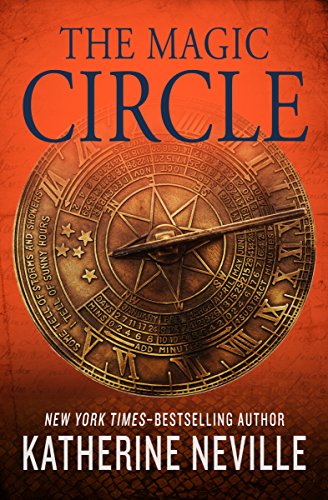
The Magic Circle
by
Katherine Neville

The Magic Circle is an ambitious novel, and for that I commend Ms. Neville. However, it was a challenging book to read. I loved the heroine, Ariel, but the family relationships—and there are many limbs on the tree—became increasingly difficult to follow. By the end, I really had no idea who was related to who, and the romantic entanglements between ‘cousins’ left me feeling a bit off-kilter. However, there’s such an abundance of history here (a lengthy backstory starring none other than Jesus) and an odd side-story involving Hitler, that it’s clear that Neville worked hard on this massive book. My favorite character—Sam—didn’t have enough screen time, but Ariel was a strong protagonist, if not a little too trusting of the men in her life. Despite my frustrations with this novel, it's definitely worth a read.

Find The Magic Circle at Amazon

*****


A Calculated Risk
by
Katherine Neville

Verity Banks is the youngest female executive at one of the largest banks in the world. When her boss sabotages her chance to become Director of Security at the Federal Reserve, she decides to do something daring—steal from the bank, use it to earn 30 million dollars, and return the money before anyone realizes what she’s done. To aid her in this quest, she joins forces with a former mentor—a brilliant computer scientist, Dr. Zoltan Tor. This book was published in the 1990s, and the technology reflects it, but it offers a fascinating peek at data management thirty years ago. It’s a clever cat-and-mouse game with high stakes and romantic elements between Verity and Tor. I really had fun reading it.

Find A Calculated Risk at Amazon


*****


The Tuesday Club
by
Katherine Neville

This short story is classic Neville, with a collection of historical figures front and center. While in France, Benjamin Franklin is called upon to decipher an encoded message from Scotland that could have startling ramifications for the fledgling United States. As he deciphers the missive—and very cleverly, I might add—he bounces ideas off none other than Thomas Jefferson and John Adams. This quick read is delightful, with a really shocking twist.

Find The Tuesday Club at Amazon

Tuesday, March 5, 2019

Sailing The British Virgin Islands


By Kristy McCaffrey

“Who is staring at the sea is already sailing a little.”
~ Belgian author Paul Carvel


I am not a sailor, but I recently lived the life of one. Last month, my husband and I sailed on a private catamaran around the British Virgin Islands, or BVI as the locals refer to it. And we fell completely under its spell.

The Moorings dock at Road Town, Tortola, BVI.

We sailed on a crewed 5800 yacht with The Moorings, one of the largest charter companies in the world. Our starting point was Road Town, located on the island of Tortola. Although many people fly to nearby St. Thomas, located in the U.S. Virgin Islands, we opted to connect through San Juan, Puerto Rico, which required a brief flight in a propeller plane to Beef Island.

Our plane from San Juan, Puerto Rico,
to the British Virgin Islands.

The airport at Beef Island, Tortola, BVI.

All told, it took us two days of travel at the beginning and end of our 5-day sailing adventure, but it also meant that we had time to adjust to the time change (thankfully only three hours) as well as regaining our land-legs before heading home.

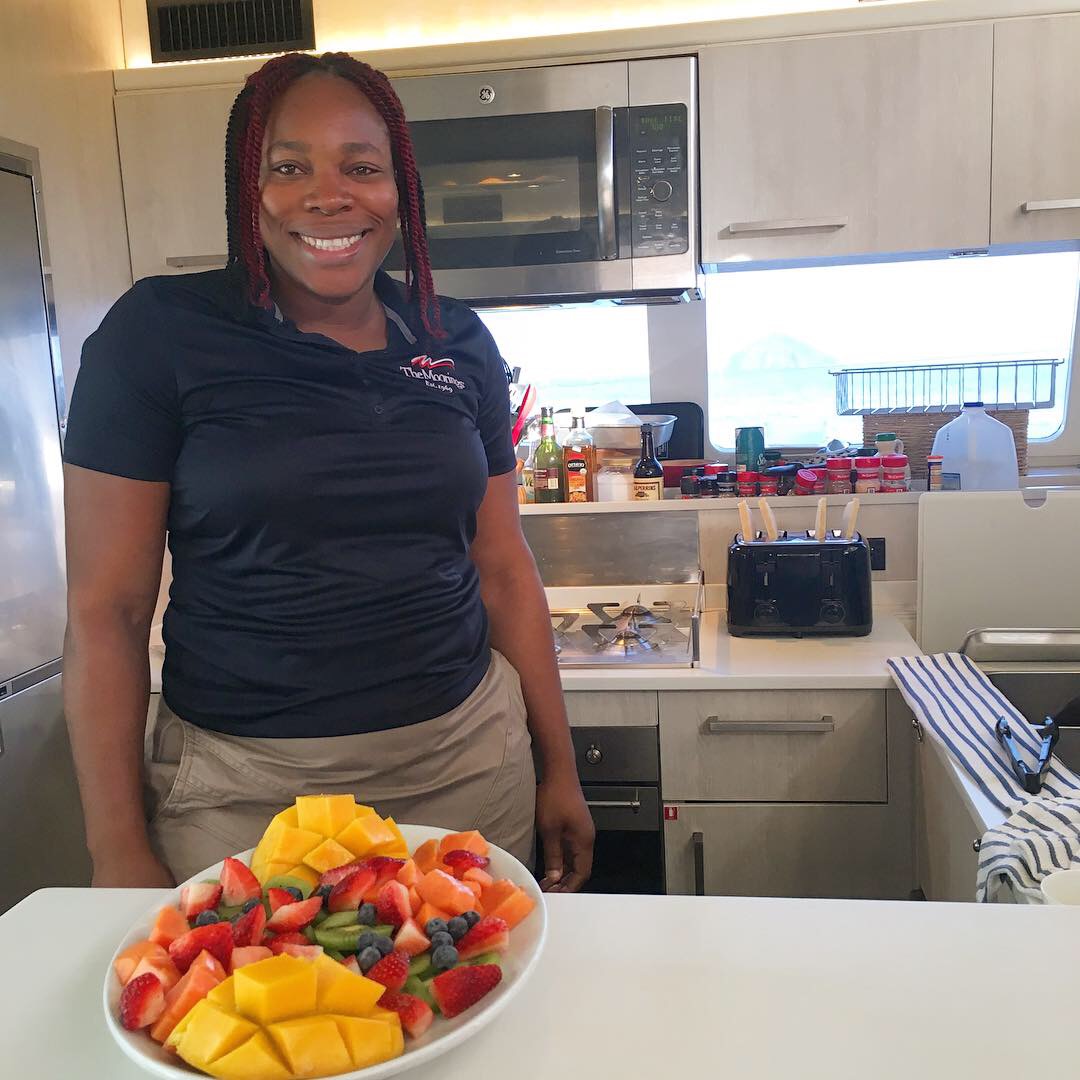
Our international crew: Chef Kay, Captain Derek,
and Steward Grant. (Kay was from Jamaica, Derek
from the U.K., and Grant was from South Africa.)
Eight of us boarded our catamaran on a Sunday morning and were greeted by our Captain, Derek, our cook, Kay, and our steward, Grant. The entire crew was professional, friendly, and made our entire week an unforgettable vacation. Each of the four couples had their own private cabin that included a private bath and adequate closet and cabinet space, but be sure to pack using a duffle bag as those are easier to stow.

Leaving Tortola for our 5-day sailing adventure.

On a side note, one benefit of visiting the BVI’s, at least for Americans, is the use of U.S. Dollars, U.S. electrical outlets, and a strong wifi and cell service connection our entire trip. This made it easy to stay caught up on work (although we certainly did as little as possible), and enabled us to remain in contact with our children, always a plus.

Our boat, the Laurel Lee. In the back, you can
see one of the main deck cabins.
The same cabin from the other side.

The boat had six cabins in total, with four on the lower level and two on the main level that included a forward-facing door that led to the bow. The top deck had a full flybridge complete with a helm station and wet bar, making it our main hangout for the week. The outdoor aft dining area could accommodate all of us, and the crew decorated it with a different table setting for each meal. It’s these little touches that really added to the enjoyment of the trip.

The flybridge. Very comfortable and the best place to be
while sailing (helps with seasickness).

The outdoor aft dining area. To the right you
can see our motorized dinghy, used for
shore excursions.

We had latitude in choosing our itinerary, but for the most part we let Captain Derek guide us, since he knew the islands far better than us. Our first stop was Cooper Island, population 44, not including the wild goats roaming the shoreline. At most of our stops, we were moored off shore and could use a tender to visit dry land. However, we were so close to the beach of Cooper Island that my husband and I jumped in the water and snorkeled over.

Our boat. We had the use of paddle boards
and a 2-person kayak.

Most evenings, we were moored offshore.

There's nothing like the wind in your sails.

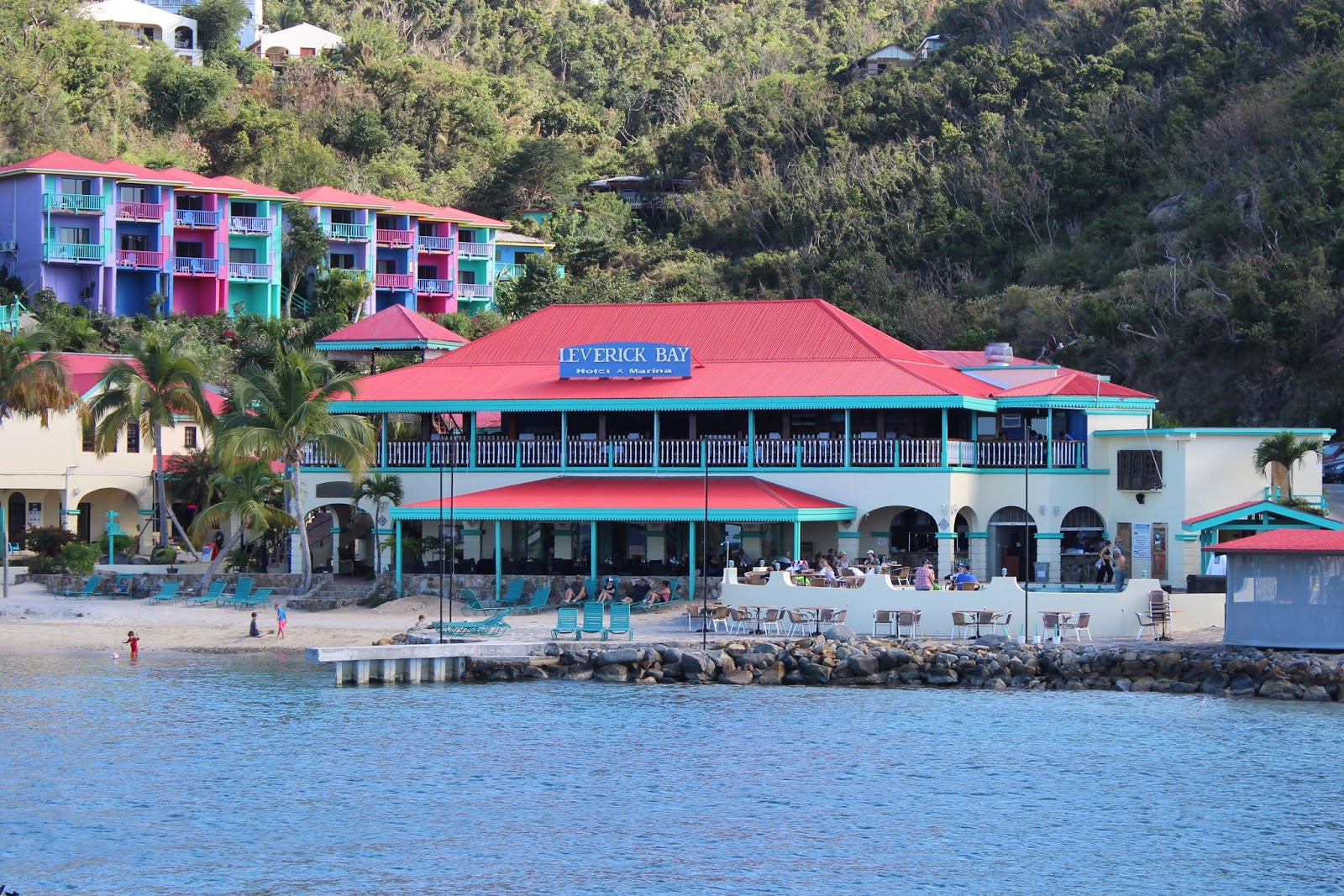
Speaking of snorkeling, we had many great opportunities to view a diversity of fish and coral. We enjoyed the grasses of Cooper Island, the expansive Diamond Reef (near Scrub Island), the unique Caves of the privately-owned Norman Island, and the starkness of the Indians (the last two only accessible by boat). We also clambered through the rocky boulders and pathways of The Baths on Virgin Gorda, and enjoyed our parking spot at the dock at Leverick Bay (which meant we could come and go from the boat as we pleased). It was here that we had a fleeting encounter with Sir Richard Branson, the billionaire CEO and founder of the Virgin Group (which includes Virgin Atlantic and Virgin Mobile, to name a few). He owns nearby Mosquito Island, as well as the much smaller Necker Island, both of which are a short boat ride from Leverick Bay. As we dined that evening, we caught a glimpse of him as he arrived to pick up a passenger in a small speedboat. The area is so beautiful that we can well understand why he chooses to live here.

The Caves. We were able to swim into three
different caves located along this rocky face.

The Indians. This was advanced snorkeling with a bit of a
current, but the marine life was worth it.

My husband navigating The Baths on Virgin Gorda.

Leverick Bay on Virgin Gorda, BVI.

The view from Hog Heaven Bar, a popular hangout on
Virgin Gorda that overlooks Leverick Bay.

The same view beneath a full moon.

One of our favorite stops was Anegada, the northernmost of the British Virgin Islands. While the islands of the BVI and nearby USVI are volcanic and mountainous, Anegada is formed entirely of coral and limestone, making it flat and low. The name is derived from the Spanish term for the flooded land, tierra anegada, with its highest point only 28 feet above sea level. The main activities here are kitesurfing, horseshoes, and a whole lot of doing nothing. We skipped the traditional lobster dinner that came highly recommended to us because we’d become quite loyal to our own chef, Kay. Her meals were made with fresh ingredients, homemade entrees and sides, and a whole lot of love, and we didn’t want to miss a one of them.

Anegada Island, BVI.

Anegada Island, BVI.

My husband and I in full vacation mode.

Our wonderful chef, Kay, and all the amazing meals she
prepared for us.


A little history of the islands: The Virgin Islands were first settled by the Arawak from South America, but the first European sighting was by Christopher Columbus in 1493. He named them Saint Ursula and her 11,000 virgins. The entire area is still recovering from the devastation of Hurricane Irma in September of 2017, but the magic of the place is palpable. In addition to wild goats, there are also wild chickens everywhere. And while I’m a true animal lover, I must admit that the roosters nearly drove me insane with their incessant crowing. They are endlessly annoying and the only saving grace is their gorgeous coloration. But the hens and the chicks are the personification of cuteness and thankfully make up for the cockiness of the boys.

A wild rooster of Tortola, BVI.

A hen and her chick on the beach at Brewer's Bay, Tortola, BVI.

Our last day was bittersweet, because we didn’t want our time on the water to end. Kay prepared a wonderful breakfast (frittata, fresh fruit, crispy bacon, and toast), and then we packed up our rooms before motoring across Sir Francis Drake Channel.

Our last breakfast.

A pretty and cloudy day greeted us, and the sea offered only a bit of chop. Within an hour we had arrived back at Road Town, thoroughly impressed with Captain Derek’s parking job as he expertly maneuvered the giant catamaran while dodging a strong wind. We spent the night on Tortola at a quaint inn on Brewer’s Bay, and I indulged dining on my favorite dish of fried plantains while pelicans and boobies entertained us with their fishing technique: dive-bombing.

Brewer's Bay, Tortola, BVI.

Fried plantains (and my husband's last cigar LOL).

As I think back to my time aboard the Laurel Lee and sailing the British Virgin Islands, the sea continues to whisper in my ear, and I’m certain that saltwater now fills my veins. And for a brief time, I was a sailor.

Sailing the British Virgin Islands. I wholeheartedly recommend it.


Tuesday, February 26, 2019

Old Spanish Mines


By Kristy McCaffrey

Long before the westward expansion of the United States, the Spanish were present. Markings on a canyon wall in central Utah consisting of a cross symbol bear the date ‘1667’. Hieroglyphics and pictographs originally thought to be placed by Native Americans are actually markers along the Spanish Trail, which led from Mexico to the Uinta Mountains (in Utah) and beyond. This trail was the main link between Mexican and Spanish outposts, and it’s posited that they were religious outposts. The Spanish presence lasted well into the 1800’s, when packs of Mexicans were reportedly leaving the Uinta Mountains laden with gold.

The Uinta Mountains of Utah.

Until the 1800’s, the tales of the Spanish gold mines were the subject of Native American history, with few white men knowing of the mines. The Spaniards used the Native Americans as slave labor, and after many years of oppression it’s believed that they revolted and killed most of their Spanish captors. Supposedly the Native Americans returned the gold bullion to the earth and sealed it in the very mines from which it had come.

Thomas Rhoades

Thomas Rhoades, a close assistant to Mormon Church leader Brigham Young, was one of the first white men to fully understand the implications of the Spanish mines. Young had become a religious mentor to a Ute Indian named Chief Walkara, who spoke of a secret cache of gold in the Uinta Mountains. The chief agreed to give the gold to the church, and Rhoades was selected to transport it to Salt Lake City.

Unfortunately, the Indians refused to remove the gold, believing it to be cursed. But it was easy for Rhoades to transport since it was already mined and left in bullion form. His first trip was said to have lasted two weeks, yielding more than sixty pounds of pure gold. For several years, Rhoades continued to transfer gold until, in 1887, he discovered additional mines located off Indian ground. This spurred interest in the lost Spanish gold mines, since it appeared there wasn’t just one mine to be found but many.


Searching for the mines could be deadly. In the early years, stories circulated of prospectors being shot and killed, often by Native Americans protecting the sacred mines. Even as recently as 1990 there have been reports of modern-day prospectors being fired upon as a warning by Native Americans who protect the land near historic mining operations.

Old-timers in the Uinta Mountains have claimed there are seven mines lined with pure gold that supplied the Aztecs, serving as the basis for the seven golden cities of Cibola sought by early Spanish explorers.


In ROSEMARY, Book 11 of the Widows of Wildcat Ridge Series, Rosemary goes in search of the fabled Floriana mine in the wilderness of the Utah Territory in 1884. While The Floriana is a fictitious mine, I based it on tales of the time.


Rosemary Brennan is recovering from the loss of her husband five months prior in a devastating mine accident that took the lives of nearly all the men in Wildcat Ridge. The mine owner, Mortimer Crane, has given the widows an ultimatum—find husbands or he will evict them from their homes and businesses. Desperate to keep the assay office that her deceased husband had managed, she heads into the hills in search of an old Spanish mine called The Floriana in the hope she can lay claim to a bonanza of gold.

Ex-U.S. Deputy Marshal Miles McGinty arrives in Wildcat Ridge to pay his respects to Jack Brennan’s widow. He and Jack had a history, and Miles is heartsick over the loss of the young man he had come to think of as a brother. When he learns of Rosemary’s problems with the piggish Crane, he will do anything to help her—even offering marriage. But when it becomes clear that Crane knew of Jack’s criminal past and was blackmailing him over it, Miles must decide whether to tell Rosemary the truth, because doing so may drive her away. And to his surprise, Miles has fallen in love with his new wife.

A sweet romance set in 1884 Utah Territory.